Thursday, 15 May 2014

One tartan to rule them all?

So I was about to start painting the highlanders that I've got ready for Whiskey Priest's Oldhammer challenge, when suddenly I was paralysed with angst and self-doubt.

Not so much an existentialist crisis as an example of the kind of annoying niggles that crop up everytime I need to make a big painting decision. And the big question causing all the hesitation was this:
Should I paint the kilts of the clansmen all in one tartan, or should I go for a load of different tartans?


An incident in the rebellion of 1746, by David Morier - note the highlanders are wearing several different tartans.

If I was an historic gamer, there might be a somewhat definitive answer to that: if I was wargaming the Jacobite uprising, say, the evidence would point to the fact that the warriors wore a whole gaggle of tartans. Certainly the idea of everyone wearing a common "clan tartan" is a much later development, and in terms of battle dress has more to do with the raising of the Highland Regiments in the 18th century, when each regiment was dressed in a uniform tartan. It's only really with the highly dubious claims of Vestiarium Scoticum of 1842 (largely a historical fabrication - FABRICation, geddit? eh? HAHAHAHAHA oh forget it) that we derive the idea that there was such a thing as historic tartans associated with particular clans, taken up by the Highland Society of London... and kiltmakers have been trading on that ever since. So it's kind of a 19th century fantasy of how Scottish highlanders used to dress. But then, what we're wargaming here is fantasy.

The Albion clansman designed for McDeath, all decked out in their highland dress, inhabit a romantic dream, born of Sir Walter Scott's "Land of brown heath and shaggy wood,/ Land of the mountain and the flood", but in the hands of the Games Workshop designers it's a dream cut through with 1980s British cynicism... competitors at the Highland games become rival football hooligans armed with broken bottles facing off over the playing field. (Incidentally, the Warlord Games "arrant scum" selection of beer swilling highlanders captures this mixture of romance and hooliganism quite nicely.) High fantasy with a vein of snide humour.

Such is the nature of fantasy - the past as it is imagined, and as we use it to tell stories about the present, not than the past as it was lived. So ultimately, the question is which fantasy I want to depict when I come to paint these wee fellows: the fiercely independent highlander banding together with his fellows, or the loyal men tied to kin and territory through unbreakable bonds of blood.

Monday, 21 April 2014

For the glory of the Dalek Empire

Align and advance!
Advance and attack!
Attack and destroy!
DESTROY AND REJOICE!
- Daleks in the First Doctor adventure "The Chase"

Introducing my Imperial Dalek force, assembled and painted for the recent invasion of the Lake District. Back during Blog-Con last year, I was chatting with Thantsants and Warlord Paul and commented on the fact that not only was it the 50th anniversary of Doctor Who, but it was also the 25th anniversary of Remembrance of the Daleks, the story that has lodged itself most firmly in my childhood memory.

In that storyline, 1960s Earth becomes the battlefield for a clash between the "purestrain" Renegade Daleks, and the Imperial Daleks, who had been "augmented" with parts of cryogenically frozen bodies... all the while the Seventh Doctor manipulates the Dalek forces in a most Machiavellian manner. Thantsants already had a force of daleks painted up as Renegade Daleks, so we made an agreement that I'd paint up an Imperial Dalek force and fight a Dalek Civil War.


The end result... well, let's just say I never want to have to paint gold and white ever again! I ordered my minis from Black Tree Design during their Black Friday sale back in November. Due to various mix-ups (which in the end Black Tree Designs were very apologetic about), I didn't get hold of them until February, and got to work assembling them. I think the models are lovely, and I've always coveted them since they were made by Harlequin back in the 90s... and at the sale price, they were an absolute bargain. (Black Tree Design seem to have regular sales, so sign up for their newsletter keep an eye out.) Unfortunately, time has not been kind to the moulds, and there's some minor loss of detail and pretty horrible flash, so much of my time was spent cleaning that up. It was impossible to completely clean up the mins due to the locations of the flash between the roundels and deep in the vents. Ideally, they need to make new moulds, but probably they can't do that due to licensing restrictions? Anyway, eventually after filing and cutting for hours, they were ready to put together, and then it was just a matter of painting masses of gold detail! I think I'm going to retire my gold paint now, horrible stuff and I never want to use it again.

All of these gripes aside, I'm actually rather pleased with how the army appears en masse. As with much of my painting, peer a bit closer and the flaws become visible, but having tidied them up a little I'm happy with their appearance all the same.
My force takes a few liberties with the Doctor Who canon (as does Thantsants' force), but what's the point of a long and convoluted history if you can't play around with it and splice it to your own devices? Alongside the classic Imperial Dalek warriors and Heavy Weapons Daleks from Remembrance of the Daleks, I've bought the Dalek Emperor from the Second Doctor story "The Evil of the Daleks" to act as supreme commander of my forces, and I've also got Slythers and Robomen from the First Doctor story "The Dalek Invasion of Earth" to serve as henchmen/ pawns/ all purpose cannon fodder. I especially like the Slyther miniatures because they are such a faithful depiction of a man in a plastic bag costume with some plant matter stuck to him.


For the Dalek Civil war (battle reports to follow in the weeks ahead) we used Daniel Faulconbridge's "Doctor Who: Invasion Earth" rules, published by Harlequin in 1996.

These are a fun, simple and fast moving set of rules - each model has a list of permissable actions (Move/ shoot/ hide/ assault, etc.) to choose from in a game turn; not all models can do all actions (Daleks are useless at hiding, but they can levitate; Engineer Daleks can "fix", etc.), hence each type of model has its own list; weapons are more or less effective at different ranges (from point blank to extreme), with modifiers for cover, moving and shooting, etc. Lots of D6 rolling, but things move swiftly enough to really concentrate on storyline and overall strategy. I think that with repeat playing, one would probably want to augment the rules and add more detail to them; but for the purposes of our mini-campaign they worked very nicely and accomodated everything we needed (land rovers ramming and destroying daleks, heavy weapons blasts wiping out handfuls in a single shot, and so on and so forth). I'm all for the strategic detail of 3rd edition warhammer, but all the same on this occasion it was nice to have a stripped-down ruleset that could really take a back seat to the unfolding story.

All in all, nice to "archaeogame" this 1990s ruleset, and to finally live out my dream of commanding a dalek army. Any of you guys have experience with Doctor Who: Invasion Earth?

Wednesday, 16 April 2014

Battle Report: The Poison River

Across the river, the poison river, greedy dwarves with greedy hearts cut deep into the rock. Greedy hands grasp deeper than any mortal should grasp. With every strike of every pick, evil bleeds out into the river. The gods of the river wail. The gods of the river demand satisfaction. The gods of the river thirst for justice. They thirst for blood.

We must quench the thirst of the gods. We must carry the altar across the river, the poison river. Towards the dwarves, the greedy dwarves. Upon our altar, we must bleed their greedy hearts dry.


I've been in a frenzy of painting the past few weeks preparing for a fabulous weekend of battling at the Lakes by invitation of Thantsants - more on that soon - and as a result I haven't yet had time to write up a battle report of the wonderful recent meetup of OGRE on Sunday 23rd March at Cambridge City Wargames Club. Michael (Popevaderii on the oldhammer forum) brought his dwarves and Matt brought his Wood Elves and zoats, so everything was set for a magnificent 3-way struggle. Michael has already provided an excellent and very funny account of events, but here's my attempt to recall what went on.

The scenario:
The run-off from dwarven mineral extraction has severely polluted the River Ooze and its surrounding marshes. Dark materials from deep under the ground that should never have been brought to the light of day have seeped out and are now causing terrible mutations among the creatures dwelling in the river and surrounding wetlands.

The Fimir have been charged by the gods of the marshes to destroy those who have polluted the river. They must reach the mine entrance, destroy the mines, and offer a dwarven blood sacrifice upon their war altar as atonement.

The Wood Elves seek the destruction of the mine, but must also ensure that it does not fall into fimir hands.

The Dwarves' objective is, first and foremost, simply to survive, though ideally they would like to continue their mining operations. At the start of the scenario, part of their force (primarily the miners, with some defensive support) is located around the mine entrance; the remainder of the force enters from the north east as a reinforcement answering the alarm call.


At the start of each turn, roll a D10 to find out what the blighted river has in store. Any creatures introduced by this roll appear at a randomly determined edge of a randomly determined marsh, move randomly in their first turn, and subsequently towards the nearest unit, charging when they get within range.

1. Hallucinogenic gasses rise from the river, causing each unit starting that turn within 6" of the river to believe that a terrifying monster is towering over them - test against cool to see whether they wet themselves in fear and run off.
2. Suffocating gasses rise from the river - all troops starting the turn within 6" of the river suffer a -1 toughness penalty for that turn.
3. A giant snail slimes its way out of one of the marshes.
4. D3 carrion crawlers crawl from one of the marshes (use stats of beasts of nurgle).
5. D3 demon worms crawl from one of the marshes (use stats of pink horrors of tzeentch).
6. A giant spider scuttles out of one of the marshes.
7. A ring of fungi pops from the soil by the side of one of the marshes and fills the air with toxic spores. All units within 6" of the fungi at the start of the turn suffer a strength 3 hit. The fungi remain in play throughout the remains of the game, such that any troops moving within 6" of the fungi automatically suffer a strength 3 hit.
8. A giant scorpion crawls from one of the marshes.
9. A shambling mound rises from the depths of one of the marshes (use stats of a level 5 ogre hero)
10. Intoxicating gasses rise from the river - all troops starting the turn within 6" of the river are subject to frenzy.


Battle Report:

"Can't they get here any bloody faster?" grunted the dwarf lookout from his vantage point in the tower above the mine. To the east, he could see the column of reinforcements he had sent for. Their tiny legs appeared to be moving, but they didn't seem to be getting very far. All the while, the massed forces to the south seemed to be surging forward. "Why don't they fight one another and leave us alone?" The cannon pivoted towards the zoats galloping forward and let off a warning shot.

At the command of the fimir dirach, black demon hounds appeared at the top of the hills like gathering stormclouds.


Trying to hold off the attack while the reinforcements tottered ever so slowly onwards, dwarven cannonballs smashed into the line of fimm warriors, while a dwarf gyrocopter arriving in support scattered grendades among the enemy. The fimm were left somewhat depleted in number, but marched on regardless. Beyond the hill, the demonic hounds passed through a poisonous cloud of spores, followed by the cultists carrying the war altar: weakened, but undeterred.
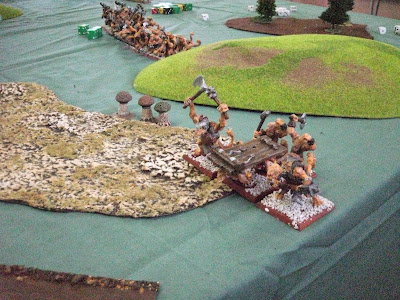

Unfazed by the approach of a giant mutated spider, the elves begin to take up a position to shoot, causing major casualties among the dwarf relief force.


Dwarf slayers roar promises of revenge and charge across the swamps towards the elves; but their way is blocked first by a shambling mound rising from the oozing marsh - then by the poison sting of a giant scorpion.
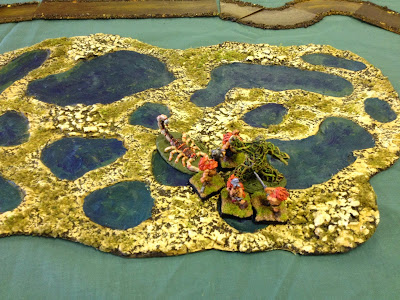

First to reach the mines were the demonic hounds. They launched themselves towards the necks of the miners, teeth dripping with spit, hungry for flesh.


While one unit of fimm warriors marched steadily towards their objective, the second unit found their willpower severely tested; to the east, they could see the effeminate prancing of the elven wardancers, hips gyrating in the midday sun. Experiencing a strange mixture of confusion, desire, and disgust, they found the temptation too great, and turned their menacing attentions towards the the elven force. While the elves tried to reorganise themselves to deal with the new threat, they found themselves thrown into further disarray by the pffut pffut pffut of the dwarf gyrocopter overhead. "Take that, ye tree-huggers" screamed the pilot, lobbing grenades into the midst of their forces.


Across the river, the dwarf thunderers took aim at the wardancers, cursing as the bullets seemed to bounce off their sparkly warpaint. The volley of arrows sent in retalliation by the elves was merciless, nearly wiping out a whole unit of crossbowmen - the remaining crossbowman immediately took the slayer oath, vowing to avenge the deaths of his comrades. Charging into the marsh he became embroiled in the same struggle as the other slayers, who were still trying to handle the mutated inhabitants of the swamp.

The miners were locked in battle with the black demonic hounds, pushing towards an eventual triumph, while the heroic guard of the mines lobbed dynamite into the midst of the fimm warriors who were now advancing across the river. If they wanted to get to the mines, they'd have to take him on... which is exactly what they did.


The elves continued to rain down pointy death - first robbing the slayers of glory by killing the swamp creatures they had been battling with, then, adding injury to insult, killing the slayers with a further wave of arrows. At the same time, the pilot of the dwarven gyrocopter was blinded by missle fire and crashed his machine into a swamp. Then, a sound like the cracking of a whip, only a hundred times louder... followed by the sounds of screaming and the crumbling of masonry. The battle seemed to fall silent for a second. What had happened?

All eyes turned towards the tower at the head of the mine - or rather, the place where the tower had been only seconds before. Suddenly reduced to rubble by the chanting of a Zoat priest intoning the word "Raze" in an ancient tongue. As the structure crumbled, the dwarf cannon and its crew, as well as the dwarven guard, were killed, with several of the fimm warriors at the foot of the tower also crushed to death.


The mine was destroyed. The elves had achieved their goal. But the Fimir were not satisfied; they had not yet made the offering of blood that would please the obscure gods of the marshes. And so they resolved to push on. Until they looked up and suddenly saw towering above them a FIFTY FOOT DRAGON WITH SEVENTEEN FEROCIOUS DEMONIC HEADS AND TWENTY WILLIES THAT HISSED LIKE SNAKES AND CLAWS LIKE GIANT MEATHOOKS AND A WALL OF CRAWLING MAGGOTS WHERE THEIR SKIN OUGHT TO BE!!!!!

In fact they saw nothing of the sort. What they were experiencing was simply a hallucination brought on by the gasses emanating from the polluted river. But it was a bloody powerful hallucination, causing almost the entire fimir force to flee. Both units of fimm, and even their Warlord Gislea, turned and ran in terror. Only the cultists accompanying the remained to advance.


By the time the fimm warriors rallied, they found themselves in danger's way. One unit of fimm found themselves under further threat from a shambling mound. Just a little further to the east, the unit of fimm warriors closest to the wood elves were within charge range of the zoats, who having achieved their objective of destroying the mine, now sought to achieve their secondary objective of stopping the fimir. Driven to frenzy by the chanting of their priest, the zoats ploughed into the fimm and began to hack at them - they were soon joined by a giant scorpion scuttling towards the flank of the fimm.


Elsewhere, the elven wardancers charged into the dwarf handgunners to remove that threat, while the Fimir Warlord, finally recovering from the effects of the hallucinogenic gas, now found himself alone and exposed to the bright light of the sun. Away from the protective mist generated by the rest of his clan, he stumbled blindly like an idiot - straight into the field of poisonous mushrooms. (He failed his stupidity test on a double 6, which we deemed a critical fail, so felt he had to do something really stupid.)

Struck by a severe case of the munchies, he leaned over to take a bite - a snack that brought him nearly to death's door. (He was left with only one wound after this error of judgement.)

Seeing that most of the fimir were now otherwise engaged, and that the elves were increasingly turning their attention to the one-eyed enemy, the dwarves began to hold the line, and move their reinforcements ever closer to the collapsed entrance of the mine. The fimir cultists, carrying their war altar, charged the miners. They would have their blood, or die trying. The dwarven reinforcements were edging nearer, unmolested by the fimm warriors still locked in combat; yet very few could survive the continued harassment of the elven arrows.

With the altar guard struggling to dispatch the miners in a timely fashion, they were charged by the Dwarven General. All hung in the balance. The cultists struggled to survive the attentions of the Dwarven General's vampiric blade, while the plucky dwarf seemed to grow in stature with every blow - almost reaching the height of 5 foot, it seemed. Gislea, suddenly brought to his senses by his light lunch on poisonous fungi, but still feeling thoroughly wretched, made his way to the ruins of the mine. The snarling dwarf general fought on, but he was no match for his cylopean foe.


The last thing the dwarven general heard was the wailing of a fimir cultist as his wrists were chained to the altar. "Godsss of the river, godss of the marsshhhess, restore yourselvess! Drink deep of the blood that issss rightly yours!"

Then all was darkness.

Monday, 24 March 2014

Of Black Shuck, and other terrors

"They do speak of a dog that walks regular. His eyes are big as saucers and blaze wi' fire. He is fair as big as a pony, and his coat is all skeffy-like, a shaggy coat across. He has a lane, and a place out of which he come, and he vanish when he hev gone far enough." - account of a demonic dog near Garveston in Norfolk, from Enid Porter's Folklore of East Anglia.

"Black Shuck, that dog don't give a fu.." - The Darkness, minstrels of Lowestoft


Yesterday saw another nice little gathering of OGRE, the East Anglian regional oldhammer group, with an exciting 3 way battle between Dwarves, Wood Elves, and Fimir around a polluted river. Pictures and a battle report of that encounter to come, but in the meantime I thought I'd keep ya'll updated with the latest additions to my fimir force.

In trying to create an East Anglian theme for my Fen-dwelling fimir, I'm always on the lookout for inspiration from regional folklore. One of the most widespread stories that spread around East Anglia (and to a certain extent persists to this day) is that of a giant ferocious black dog, with glowing demonic eyes - known locally as "Black Shuck".

On the morning of Sunday, 4 August 1577, the people of Bungay were at prayer in their local parish church. The sky was darkened, and a storm had broken, pounding the windows and doors with heavy rain. It was as though hell had broken loose - and then, from out the gates of hell, a beast as black as the storm smashed through the door and launched itself fast as lightning down the nave. Passing between two of the townsfolk kneeling in prayer, it tore into their neck and killed them in an instant. He then launched into a third man, striking him on the back and causing him to shrivel up like leather scorched in the fire, before bounding out as quickly as he had entered. To this day, the scorchmarks from the hellish hound's claws can be seen on the church door.

Another tale of Black Shuck concerns a small blind boy standing with his sister on Thetford Bridge. the blind boy said to his sister: "Please send the big dog away", to which his sister replied, "What dog? There's no dog here." Suddenly the girl felt her brother being pulled away from her and into the water, and only managed to whisk him away home and to safety in the knick of time. Black Shuck's association with the water comes through in many other stories, including the tale of an old lady in Blickling, who told the village parson, "Don't you know that when Arthur was fishing in the lake, he caught an enormous fish and that, when it was landed, a great black dog came out of its mouth? They could never get rid of that dog, who kept going round and round in circles inside the house, till they send for a wise man from London, who opposed the straight lines of the partitions to the lines of the cricles and so quieted the dog. But if these young people pull down the partitions, they will let the dog loose again".

If my fimir force are a manifestation of East Anglian nightmares - the creatures that emerge from the mist and drag you screaming into the fens - it seems clear that I should do something to represent the nightmare of hellish dogs as black as the night and with red glowing eyes. Luckily for me, I'd just picked up for very little a couple of plastic GW sets that someone leaving the 'Games Workshop hobby' was getting rid of, and one of the boxes he was getting rid of were Fenrisian Wolves for a 40K Space Wolf army - perfect to use as Chaos Hounds on the cheap, and fitting the description of Black Shuck quite well.


Can't quite get the glowing eyes in the picture. Need a better camera! But you get the idea. I can imagine the people of albion huddled behind the barred door of an inn, waiting for the sound of the scratching of claws...

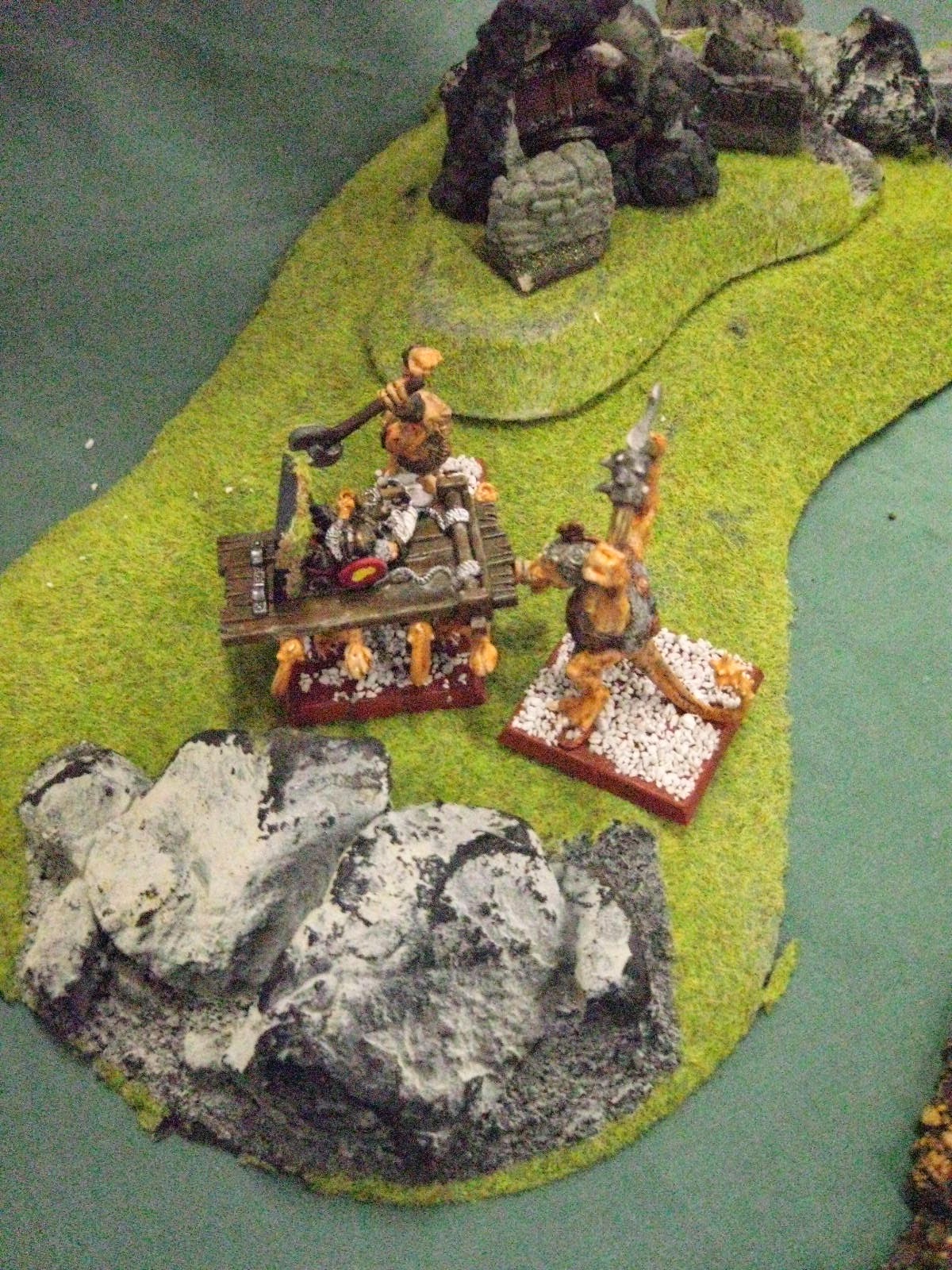
I also made a couple of other additions to the force while I was at it - my first attempt at painting a Nick Bibby fimir - this one can act as my warlord. Also, I decided for the scenario we needed a crude war altar. For that purpose I painted up the top of the heroquest rack model, and put it on the backs of two shearl (thralls from Oakbound miniatures' "The Woods" range of Myeri Marsh Demons)


Again, not a great picture, here's another one, this time from yesterday's battle - unfortunately in this picture you can also see my Warlord legging it! Why has he turned and fled? Well, you'll have to wait for my next post to find out!

Saturday, 15 March 2014

Highlanders for the Oldhammer Challenge; or, Albion as a campaign setting


(Arthur Rackham's illustration of the Scots Ballad Twa Corbies)

So I've loads of different projects on the go right now, trying to get things ready for games in the near future. But as I said in my last post, I've been inspired by Whiskey Priest's Oldhammer Challenge. In his words:
"Let's do something to show that it's all about the game and camaraderie rather than the rules and the figures. We each make a warband - a tiny army - a posse, based in the Warhammer world. A maximum of 21 figures. Two units of 10 and a hero or any similar configuration. You are entirely free to do what you want! The figures must be either a) insultingly cheap from ebay or b) easily bought from current manufacturer."

Preach on, Whiskey Priest! And I've been so inspired by this that I've decided it's time to paint these guys:


I can imagine people clucking their tongues and rolling their eyes. "Are you completely thick? Did you not read what Whiskey Priest wrote? Are you just trying to contradict him and prove that oldhammer IS elitist and exclusionary and about wasting money on ebay? Are you just trying to spit in his face and kick him in the bollocks, &c. &c.?"

Well, ok, hear me out. So yes, these are the clansmen from McDeath. They're oop, and although I didn't pay stupid money for them on ebay, they don't fall into the "insultingly cheap" category. So what relevance does this possibly have to Whiskey Priest's challenge? The thing is, for Christmas I was given a bunch of the Warlord Games Highland Clansmen from their Pike and Shotte range. There are some very characterful minis in this range - especially in their "Highlander Arrant Scum" selection. The obvious thing to do? To use these to supplement the expensive and hard to find Citadel McDeath highlanders and show how you can put together an East of Albion force using minis that out there at the moment, alongside just a small handful of oop masterpieces to satisfy the inner archaeogamer.

So this is the start of my warband: 4 Citadel McDeath highlanders; 7 Warlord Games highlanders; and 1 Black Tree Design "Jamie McCrimmon" from the Doctor Who range, who I've given a sickle from S&D models (a company that makes railway scenery accessories).


And to summarise, my reasons for choosing these for the challenge:
1) I already own them, so this is a chance to paint stuff from the leadpile rather than buy new minis.
2) It demonstrates how one can combine old and new minis to do even something as "old school" as McDeath.
3) It feeds into my current fascination, which is using Albion as a campaign setting. And the rest of this post will be about that.


Albion as a campaign setting

In GW's official material, Albion has shapeshifted a lot. Here's the depiction that oldhammerheads know and love from the 1986 campaign pack "The Tragedy of McDeath":

McDeath deals with just one chunk of Albion - East Albion, which, inspired by Macbeth mixed with a heavy dose of the cultural stereotyping that gives shape to the Warhammer world, is a land inhabited by clan-based kilt-wearing porridge-eating caber-tossing highlanders, living alongside militant trade unionist dwarf miners, mercenary orcs, treemen, and others. This is the Albion that inspires my warband.

Then fastforward to 1991 and the Warhammer novel Storm Warriors by Brian Craig:


Here, the map is a clear approximation of the British Isles, but Albion is divided into 4 separate islands, Great Albion, Albany, Morien, and Aeryn, meaning that England, Wales, Scotland, and Ireland each get their own individual island (thus allowing for further stereotyping - just non-comedic in form - by the GW stereotype factory.) From the extracts I've read, the culture described is a predominantly celt-inspired one, and the source of tension in the novel is the arrival of an "alien culture" of sinister immigrant sea elves.

The "Albion as multiple islands" model from Storm Warrior is also used in the following map, which Zhu Bajie has traced back to the (now defunct) Warhammer FRP site "Critical Hit"; bit of Anglo-Saxon thrown in here for good measure:


It's the pre-Roman celtic flavour predominates in the release of the "Giants of Albion", along with druid, as part of the Dogs of War army in the 5th edition era; Albion is the land of ancient Ogham stones and ancient magical forces; mysterious land of myth - at least, until the arrival of the Tilean "Curious Gesar". Then came the 2001 "Dark Shadows" campaign, in which Albion was a single misty, rainy, blighted isle to which Truthsayers (good druids) and Dark Emissaries (naughty druids) summoned great forces; Albion became a battlefield between order and chaos, ripping the land apart.

Here's the map from the start of that campaign:


Now the fact that there's so much variety in the background is a really good thing for the oldhammer gamer, in my opinion, because it leaves Albion open for our own creative imaginations. Let's strip it down to basics.

Deep History
The idea that Albion is home to an older civilisation - as evidenced by the Ogham stones - I think gives a deep rooted mystery to the landscape. I've always found interesting the idea that when the Romans left Britain, they left behind structures that nobody knew how to repair; similarly, I feel that Albion should be full of unsettling reminders that there was something here before, and it's something that we don't understand. Druidic and bardic religious knowledge tries to piece together these mysteries and interpret the landscape.

Topography
The key dynamic of any campaigning land is its landscape and in Albion, we have a land of highlands and lowlands; mountains and marshes, hills and mires. The highland clans of the East of Albion (as per McDeath), then, might be distinct from the more town-minded lowlanders, who trade with the Empire and are therefore far more cosmopolitan in their outlook. Yet the lowlanders are surrounded by the sinister bogs and fens where the Fimir dwell; and attempts to drain the marshes to create fertile farmland and increase the wealth of the kingdoms have led to increasing numbers of Fimir raids.

The sea, the sea
As a land surrounded by sea, Albion would have a history of settlement, trading, and raiding. Norse from the west and Sea Elves from the east would send ships to the shore; their motives sometimes peaceful, oftentimes not.

I'll probably type up more of my thoughts at a a later date, but I'm deliberately keeping this to bare bones, because I think the storytelling should come through gaming. Anyway, I hope it gives you the sense that when I'm painting up this bunch of guys in kilts, it's not just about the figures, the nostalgia, or the ruleset - it's about the story, and thinking about the world they inhabit and the way they link up with the other forces I have is all part of that process of storybuilding.

What do other people think about Albion as a campaign setting? Have I missed any key essentials out? Anyone else want to play a game there?

Saturday, 1 March 2014

Reinforcements for Clan Slea

From across the mire, the sound of doom. The moaning that haunted nightmares, nightmares of the mist that came out of the marsh and left devastation. Nightmares of slaughter, of wives and daughters stolen away. The godless wailing.

"They're playing those bloody bagpipes again..."


Finally finished painting up the wonderful Oakbound Games Marsh Demon Clubtails, sculpted by Fimm McCool - as these sculpts come unarmed, weapons are from Hasslefree miniatures (axes) and thebattleforge (clubs). Still working out what to do for basing (the gravel on the bases of the rest of my army was just an interim solution to get them to battle quickly), but other than that, ready to go. The skintone is the same as those I painted up for blog-con - a shade that my missus has described as "the colour of elastoplasts". These one eyed beauties(??) will allow me to bulk out Clan Slea with another unit of Fimm Warriors, and I especially love the command group with bagpiper, who I've given a nice tartan kilt. Alas, can't get the focus on it to give you a picture, so you'll have to take my word for it for now. In the meantime, here's a picture of the whole clan so far:


So what next? Well, I've got a big backlog of painting projects. Chaos warband needs to get done... I've finally got my delivery of daleks from Black Tree miniatures and there's loads of work to be getting on with there... But in addition to all of that I've been inspired by Whiskey Priest's Oldhammer Challenge and I at least want to make a start assembling the warband for that (using unpainted lead that I already own, as I'm on a purchasing moratorium for a little while!). So that'll be the subject of my next post, hopefully not too far in the future...

Tuesday, 14 January 2014

End of the world


So the cat is among the shit and the pigeon has hit the fans. Apparently a monthly magazine called White Dwarf is being axed and in its place there's going to be a weekly magazine called - er - White Dwarf and a monthly magazine called Warhammer Visions. In some respects this isn't big news. Firstly, it's still just a rumour (albeit one that seems confirmed), and secondly it's more a rejigging of Games Workshop's publication strategy than an outright cull. Most importantly, many would claim that White Dwarf has long been in a state of living death, reduced to the humiliating status of a hard-sell peddler with a below-average command of the English language.

But when an old friend dies (or is at death's door) it often prompts people to reflect upon their own mortality and the increasingly undeniable decrepitude of those who they grew up with. And so the question comes up: if White Dwarf pops its clogs, who will be the next to go?

For Orlygg over at Realm of Chaos 80s the not altogether outlandish conclusion is that Warhammer Fantasy Battle is itself living on borrowed time:
"Just look at the Specialist Range! With that cut, and mostly likely WD next, what is left to go to streamline the company and increase profits for the shareholders? Warhammer Fantasy Battle itself!"

Whiskey Priest at the leadpile seems to agree:
"This is really the nub of the problem. You have two product lines. Both require the same amount of capital input, support, shop space, tooling costs, warehouse space, packaging costs, printing costs, R&D costs etc etc. However, one sells a fraction of the other and it's sales are falling all the time. It's gotten to the point where it's financial viability is seriously in doubt. What do you do?"

Now to be honest, I don't have a position on whether or not Warhammer is going to be sent to the knacker's yard. I'm not well enough informed about GW's business strategy, and although I can sometimes come across a bit grumpy about the decisions they've made, in general I wish them well as they are a British business and an employer that would leave a hole if they were to simply disappear, quite aside from what it would do to the hobby.

But this does lead us onto a slightly different question: could the death of Warhammer even be a good thing? Is the game going out of print something we should actually look forward to? This is Warlord Paul's provocation:
"Won't it be a blessing if Warhammer goes though, really? A curse, lifted?"

That's what I'm going to discuss for the rest of this post.

Paul focusses on the fact that, rules-wise, we already have what we need. The early editions give us the tools for fun narrative play. Get yourself 2nd or 3rd ed and away you go. GW's business model relies on our wanting to upgrade, expand, replace - planned obsolescence. Except, really, the old rules were never truly obsolete. They're still there for anyone to pick up and have fun with, and some would argue that GW's subequent attempts to gild the lily have just killed it.

So I think Paul's is a good point. Oldhammer players have, effectively, entered a parallel universe where new rules releases, new army lists, new gimmicks have very little relevance. As long as we have some old books and some toy soldiers, we don't really need any 'upgrading'.

In that sense, Warhammer's demise wouldn't really trouble us that much. But in terms of whether it would be a blessing, I think there's a bigger point. An albatross that would be taken from around our necks. And it's one that's been hanging there a long time.


Take a look at the 3rd edition rulebook (for some, the epitome of the golden age): on page 189 it asks "Why a Warhammer world?" Why indeed. They answer that "Games are always more satisfying when set firmly within the context of a credible society", and assure us that "Suffice to say, we fully intend to expand the concept of Warhammer to include the entire world, and several supplements are already in preparation"

The message is clear: this is Games Workshop's world, and they're going to flesh it out for you. Don't get me wrong, this is a sensible business strategy. Why a Warhammer World? Intellectual property rights of course. But this makes it quite clear that the players are customers, not creators in their own right. Whose Warhammer world? Games Workshop's Warhammer World of course. Not yours.

Warhammer Armies continues this rot. Although the goal was to provide balanced armies for "tournament gaming", what we're left with is a flat-pack version of a fantasy world where you're given the pieces and all that's left for you to do is assemble them. The effect is a narrowing of imagination, a narrowing that continued apace with the army books of 4th edition and beyond.

For me, this would be the biggest and most exciting opportunity that would open up if Warhammer was to become out of print. It would kill off the idea of an "official" Warhammer world. I'm not saying that people won't look to old publications for inspiration; but why should the map of our own imaginations be coloured predominantly by 'official' merchandise? With the Warhammer IP mothballed, the world in which we actually play our games of oop Warhammer is ours to create and recreate. Sure, there's nothing to stop us already thinking up new worlds, new continents, new armies. Some of us do that already. But by and large we're operating within artificial constraints - an accidental fantasy geography that gave GW something of their own to sell. Time for people to draw their own maps, to create their own lands to imagine and explore.

A new world - indeed, many a new world - awaits.

Let's take this further: imagine GW never produced any more fastasy miniatures (it's easy if you try...) Imagine future players of warhammer fantasy battle had to cast their nets around different suppliers. No more would there be a straightforward one-to-one correspondance between an army list and a particular set of miniatures that stand for a particular unit. No, instead you'd have to mix and match, building up a motley collection from different oop and in production lines. And that collection would be unique, full of new stories - not just an indentikit army. And you'd need to think up new unit types, new rules, for the quirky models that you found from different companies.

The long and the short of it is that the Warhammer World has become a straightjacket. To a certain extent, the oldhammer movement has already set itself free from that straightjacket - it looks for inspiration from the past but isn't (too) subservient towards it. And yet still... the idea of what could happen if the stagnating pastiche that is the Warhammer World died tomorrow... well that's somewhat intoxicating.