Thursday, 27 November 2014

My son's contribution to Gnomevember


My son has been getting into the spirit of Gnomevember by making some gnomes at school. Do not be fooled by the charmingly colourful exteriors, they're mischievous little blighters. Little bit on the big side for 28mm, but still, he's putting me to shame with his Gnomish productivity.

Monday, 24 November 2014

Elementals, tricksters, or just plain naff? Some Gnomevember reflections on gnomes.

Away from Gnomevember's painting regime, and up north amidst family anxieties, on this Monday morning I retreat into a pleasant world of idle thought and imagination to offer some meanderings on the subject of Gnomes.

Graeme Davis, the designer of Warhammer Fantasy Roleplay, has celebrated Gnomevember by posting a Brief History of Gnomes in Warhammer. It seems that gnomes were one of those races that just couldn't be left out, but nobody gave too much thought as to how exactly to fit them into the Warhammer World, other than a statline: "Back in 1986, Citadel did have a few Gnome miniatures in its catalogue, so I included stats for them in the WFRP1 Bestiary. I’ve written before about how I tried to include stats for every miniature Citadel had ever made." Gnomes weren't included in the rulebook as a player race, although rules and background were written up in White Dwarf 86, and later reprinted in Apocrypha Now.

There we learn that gnomes are smaller cousins of the (already pretty small) dwarves. They are clannish, don't mix well, and spend most of their time in burrows or cavern networks underneath hill ranges. They like fishing, preferably in underground lakes: "Indeed, the Gnomic skill with rod and line is almost legendary." They have a sharp wit, and a liking for practical jokes; these characteristics have led to their being employed as jesters in royal courts.


So some excellent broad hints as to what they might be like, but thankfully left wide open for us to fill in the blanks with our own imaginations. Thus, here are 3 brief reflections on gnomes and why I think they are important:

1) Like fish through water, gnomes pass through the earth

One of the earliest written references to gnomes can be found in the 16th century alchemical writings of Paracelsus. He sees them as synonymous with pygmies, around "two spans" high, and describes them as mountain people. They are one of four representations of an element: Undines are the spirits of the water, Sylphs are the spirits of the air, Salamanders are the spirits of fire, and Gnomes the spirits of the earth. Each of these beings inhabits their element, breathing it, passing through it; and so too do each of these beings have a particular element as a "soil" in which to grow their food - for gnomes, water is this "soil" (which would explain the fishing rods, I suppose). God created each of these as guardians of their element. Gnomes are the guardians of the earth.

Hence, Gnomes are elementals. Not only do they have an affinity with the earth, a sense of that element being their home, passing through it as easily as fish through water, they embody the essence of the earth and are protectors of it.

2) Gnomes are the epitome of naff

Back in 2013, Ikea produced an advert that featured a middle class couple replacing their garden furniture with generic Scandanavian crap, only to have their garden gnomes fight back against the bland psudeo-modernist aesthetic. The couple are left with no alternative: they must slaughter the gnomes, each and every one.

Some people didn't like the advert and complained to the Advertising Standards Authority. But the message was clear: gnomes are naff. They are suburban, twee, sickeningly cutesy, everything we love to loath.

Maybe gnomes are naff. And that's why the Warhammer World needs them now more than ever. Without rehearsing the old anti-GW arguments, with which everyone's familiar, especially in these "end-times" times, right now in Warhammer everything is big, apocalyptic, grimmer than grimdark, END OF THE WORLD EVERYONE WILL DIE, massive multi-part plastic toys will RISE FROM THE EARTH AND DEVOUR US ALL and there will be SLIME and SKULLZ and WAR. In such a world of idiotic hyperbole, these little gnomes are completely out of place. They're too small. They're kind of cute. They don't conjure up images of endless war and suffering. That's why they are important, and why I'm going to make sure that at least a few of my gnomes have red pointy hats and white beards. Their very presence reminds us of the pathetic aesthetic and stops us getting carried away by a narrative arc so unbelievably hackneyed that it makes Dan Brown look like Dostoevsky.


3) Gnomes are the tricksters of the underground

Gnomes, like their close ginger-haired relatives the Leprechauns, are troubling because we don't know whether to take them seriously or not. Are they mocking us, tricking us, or warning us?

From British Goblins, by Wirt Sikes (1880): Under the general title of Coblynau I class the fairies which haunt the mines, quarries and under-ground regions of Wales, corresponding to the cabalistic Gnomes. The word coblyn has the double meaning of knocker or thumper and sprite or fiend; and may it not be the original of goblin? It is applied by Welsh miners to pigmy fairies which dwell in the mines, and point out, by a peculiar knocking or rapping, rich veins of ore. The faith is extended in some parts, so as to cover the indication of subterranean treasures generally, in caves and secret places of the mountains. The coblynau are described as being about half a yard in height and very ugly to look upon, but extremely good-natured, and warm friends of the miner. Their dress is a grotesque imitation of the miner's garb, and they carry tiny hammers, picks and lamps. They work busily, loading ore in buckets, flitting about the shafts, turning tiny windlasses, and pounding away like madmen, but really accomplishing nothing whatever. They have been known to throw stones at the miners, when enraged at being lightly spoken of; but the stones are harmless. Nevertheless, all miners of a proper spirit refrain from provoking them.

This is the mythology of the "knockers", gnomes of the Welsh and Cornish mines. Good luck or ill omen? The sound of knocking was the creaking of the earth and the timber supports that preceded a cave in. Were they malevolent creatures who caused the cave in? Or well meaning creatures who warned the miners in time for them to escape?

The dark creaking claustraphobia of the mine is pretty anxiety-inducing. And just as I like my fimir to embody longstanding cultural anxieties about the fens and marshlands, I like that the gnomes embody an anxiety about the dangerous underground where they make their home. You do not know whether to trust them or not. They are tricksters within the depths of the earth.


Next up, I'll consider alternative gnome models and how they line up next to the classic C11 Citadel gnomes.

Tuesday, 4 November 2014

Gnomevember!

Been a while since I updated the blog... to be honest, been in a bit of a hobby slump these past couple of months. It's not so much that I've lost interest, just that the energy expended in the run up to the Oldhammer weekend, and the excitement of the Bring Out Your Lead itself, meant that there was going to be an inevitable crash afterwards. Anyone else experience these post-BOYL blues? Added to which I'm very busy with work (and I'm lucky enough to do work that I love) and that's minimised any time or energy that I haveto get out the paints or get to games.

Part of the problem is that every time I had the urge to do some painting, all of the projects I've planned just seemed a bit overwhelming. So I decided I needed something a bit different, a manageable and interesting challenge to get me back in the game. I was considering doing something for Orctober, but I came a bit late to that. So what works for a November challenge..?


Welcome to GNOMEVEMBER!

One of the most underrepresented of the oldhammer races, gnomes are full of character. Granted, the classic citadel minis can be a bit pricey on ebay, but many of us have a few kicking about, and there are alternatives out there that are worth looking for.

Seeing as I have 13 classic models already (12 citadel, 1 grenadier), I reckon I have a good number to start a small skirmish force/ allied contingent. There are always scenarios that need a few gnomes!

So over the next month, I have a few aims:

- Get some of these wonderfully quirky minis painted

- Explore the mythology of gnomes and get a sense of how they might feed into narrative games

- Get hold of some of the gnomes that are being produced by various companies today, and see whether or not they can fit alongside the old citadel models.

...and maybe even get a game in with them!

Anyone else want to join me in celebrating Gnomevember? Come on, is anybody's oldhammer collection truly complete without a bunch of these wee fellas?

Sunday, 17 August 2014

Plague Artillery


"And on the lands near Ida's towers,
A loathsome toad she crawls;
And venom spits on every thing
Which cometh to the walls"

- from the ballad 'The Laidly Worm of Spindleston Heugh'

Well, the unconstrained joy and the sickly hangovers that characterise Bring Out Your Lead 2014 are only now beginning to fade from memory, and soon I hope to type up a couple of battle reports from this most wonderful of weekends. Others have done a sterling job recording what it was like: see Orlygg here and here and see Warlord Paul here. I'm not going to attempt a grand scale review of proceedings, just give a very partial account of the kerfuffles I was involved in, but before that I thought I'd introduce of the newest weaponry at the disposal of Clan Slea: my Swamp Toad Plague Artillery.

In my search for creatures that (literally) ooze all things marshy and swampy, toads and frogs were very high up on the list. In particular, I was keen to exploit the medieval idea that toads spit venom, acid, bile, and all manner of unpleasant things, as clearly expressed in the ballad above, in which a woman is turned into a spitting toad. This theme is picked up in the Fighting Fantasy series in the (rather obviously named) SPIT TOAD, a man sized toad that spits acid into its victims eyes before devouring them - you can find these charming fellas in Island of the Lizard King.


So when I saw the Nurgle Plague Toads that Forge World were producing, I felt they were the ideal addition to my fimir army; and with the size and design of them, they immediately suggested a kind of artillery piece - a sort of plague mortar spewing forth disease and bile onto the enemy. The only problem was the cost - they're not the cheapest things in the world. But then I was lucky enough to pick up a set on ebay in the United States. They weren't offering postage to the UK, but I got them sent to an address in the US and then asked my long suffering wife to bring them back to the UK in her luggage.

For handlers, I've used Bog Raiders from Blood Moon Miniatures. Compared to other fimir-substitutes, these lads are definitely what you might call ripped. They have muscles peeking out from their muscles. It's a bit unsettling, like some kind of dodgy infomerical advertising ab crunchers. For this reason, they don't necessarily fit in with other not-fimir, and I do really REALLY hate the way that they come in so many little bits; having to assemble a single infantry model from 4-5 metal pieces (that aren't even that interchangable) is definitely not my idea of fun. So for that reason, they're never going to get a ringing endorsement from me, although I have to admit they do paint up quite nicely.

The plan for the siege game at BOYL was to have these buggers spreading death and disease among those cowering behind the castle walls. Did we succeed? All will be revealed in the next exciting installment...

Thursday, 3 July 2014

The Forgotten Goddess: background for Gauntlet 2014


Some gods are so frequently troubled by the contradictory requests of men that they are driven to madness. Far luckier are those gods who are forgotten, free from men's desperation, untroubled and at peace.

Such has been the blissful fate of the goddess Deva for many centuries; her temples left forgotten, her shrines covered with ivy and moss. The river that bears her name tumbles by carrying her memories to the sea.

Curse the hunger of the indiscriminate. Curse their greed. To the mouth of the river came the Norse, hungry for plunder, ready to strip whatever meagre ornaments still remained in the places dedicated to the honour of Deva. Their desecration has awakened the goddess. From the highlands came the forces of the Earl McSalmond, drawn to the valley at the goddess' will, though they know not what they defend or why. From the great ocean the goddess called the seafaring elves, knowing that they stood ready to protect that which is sacred.

But the goddess' call was not only heeded by those who could come to her aid. The forces of the blood god hear the call and see the chance to desecrate that which is pure. And now the forces of the god who revels in the destruction of all other gods come to play their part - to foil the plans of the blood god or to feast on what remains of Deva's memory?

Cursed be the day that the goddess Deva was remembered. Cursed be those who would not let her rest in peace.


This Saturday, 5 July, four of us oldhammerers - Warlord Paul, Thantsants, VanLoon, and myself - will converge on Gauntlet, the show run by the Deeside Defenders. It's at the Airbus Dining hall, above the Wings Social Club, Broughton, near Chester. If you're in the area, why not join us? (And a couple of us may return on the Sunday too.)

We're each bringing a small force of around 400 points, so that there's at least a fighting chance we might get a couple of linked games in; Paul's bringing his Unwanted of Malal, a wonderful force put together from the plastic kits given to him by the disenchanted. VanLoon is bringing a Khornate force. Thantsants is bringing some Norse, and I'm bringing some mcdeath style highlanders (I'm hoping to also bring Sea Elves for maximum narrative flexibility). Of course, the best laid plans o' mice an' men gang aft agley, so some of the crucial bits and pieces I wanted for conversions to get my highlanders ready haven't come in the post. That said, I still have a modest force and I think with a bit of imagination and lateral thinking I'll have them ready for the fight. I'm very excited to see what everyone else is bringing.

I've come up with the narrative above to give some explanation as to what we're all doing in this corner of Albion, and I've drawn on some of the local place name history to give it some regional appropriateness. (The picture above is of Minerva's shrine in Chester.) Incidentally, if any of you guys can bring terrain that will help with the background - e.g. anything ruined temple or shrine or monument like, and anything that would work for a river/estuary environment - that would be great. But I reckon we can make a good go of whatever people have to hand!

Will the awakening of Albion's forgotten Goddess rip the land apart? Or will she be allowed to rest in peace, freed from the attentions of a disturbed world?

Thursday, 26 June 2014

Fighting Fantasy: The Warlock of Firetop Mountain

This is the start of an occasional series of musings about the Fighting Fantasy books. I'm going to be playing through them in turn - at least, through those of the series set in Titan, seeing as fantasy settings are my primary interest. I'm not going to type up playthroughs (because that would be boring and involve spoilers), and I don't want to write these as book reviews exactly. What I want to do is take inspiration from each of the books, and to jot down the ideas that they give me for future gaming.

Starting, of course, with the one that started it all, Steve Jackson and Ian Livingtone's The Warlock of Firetop Mountain from 1982.

The real beauty of the book, for me, lies in the illustration. The cover by Peter Andrew Jones is nice, but above all I'm talking about Russ Nicholson's drawings inside the book. The work that Russ Nicholson does here is truly amazing. I firmly believe anybody interested in old school gaming should take some time to study the atmospheric depth of his pictures. To pick up on the theme of technique vs imagination, here's somebody who's a master of his craft - the draughtmanship is exquisite - but whose primary goal is to give us pictures that our imaginations can drink from. With a lot of fantasy art, the effect can be limiting: "oh, that's not quite how I imagined it" or "oh, so that's what it looks like. I guess I don't have to imagine it anymore". What's wonderful about Russ Nicholson's work is that it doesn't do that, it leaves enough mystery in there that you still need to figure it out, and there's always that question: "what lies beyond the next corner". He's not doing the work of imagination for you, he's feeding your imagination, and that's his great achievement.


Ok, onto the text. Love the topographical description in the first entry. Topography is a big part of setting the scene, but all too easily overlooked.

This is a classic dungeon crawl, hacking and slashing your way through, moving steadily onwards and thinking with your sword. Nothing wrong with that, although I guess a bit more depth would be nice, but this was only the first book in the series. Some people have complained that the construction of this kind of classic dungeon is a bit haphazard; all kinds of enemies thrown in with no explanation of what they're doing there, and seemingly random encounters. Why is there a shopkeeper? Why is there a boatkeeper? How does he make his money - who's actually going across this river? Of course, the need to try and give the dungeon some kind of reason is what led to the classic "The ecology of the..." series in Dragon magazine. You can't just stock a dungeon, there has to be a reason to it, an ecology, an economy, and so we get these somewhat bizarre "The ecology of the vegepygmy", "The ecology of the beholder" articles. But I have to say, in defence of the seeming randomness of dungeon encounters in this book, I rather like it. Why do we move from a cavern to a splendidly decorated room with a polished marble floor and portraits? Why is there a little old man in a rocking chair? Why does the Warlock leave the very things that can destroy him lying around? I can't answer all those questions, but I think that realism is just one tool in fantasy narrative. Not everything has to be completely realistic, and at its best these kind of encounters meld into something like a dream sequence... I call this dream realism, a narrative that looks to capture something of strangeness of the dream, with all of the unconscious connections and segues and symbolic wierdness you get in a dream (or a nightmare), rather than being slavishly chained to the "real world" of logical causality.


Then, in the second half of the book (the half written by Steve Jackson - the two authors split the labour between them), you get to the labyrinth. Bloody hell, what a boring sequence of entries!

"You arrive at the junction and this time turn northwards. Turn to 262"
"Some way up the passage you reach another junction where you may either go eastwards (turn to 199) or turnnnnnnnnn zzzzzzzzzzzzzzzzzzzzzzzzzzzzzzzzz..."

And yet... and yet... I have to say I actually got lost. Very lost. Completely and utterly disoriented, ended up going around in circles, and it took me ages to get my bearings. It was a frustrating gaming experience, but it was certainly an immersive gaming experience. Really felt like I was going around in circles in a dank tunnel. I'm not suggesting that boredom should be part of the toolkit of narrative gaming (or am I?) but this section, because of the sparseness of the text, because of the circularity of the movement, and above all because of how frustrating it was, really gave me a sense of disorientation that I don't think I've experienced in gaming before. Disorientation and frustration as narrative tools...

The big boss baddie at the end was too soft and easily dispatched, and I was left wondering on more than one occasion why I was so set on killing him in the first place. But the idea of killing him in order to replace him, to become him... and to wait for somebody to come and kill me to replace me and to become me... that's an interesting one.

"The priest who slew the slayer,
And shall himself be slain."
- Thomas Babbington Macaulay, The Battle of the Lake Regillus; recalls the legend of the priesthood of the Goddess Diana at Lake Nemi. The only way to hold the honour was to slay the prior incumbent in a trial by combat. And then to wait...

Saturday, 17 May 2014

Technique vs imagination


Interesting exchange of views on the Oldhammer facebook group about this historic figure:

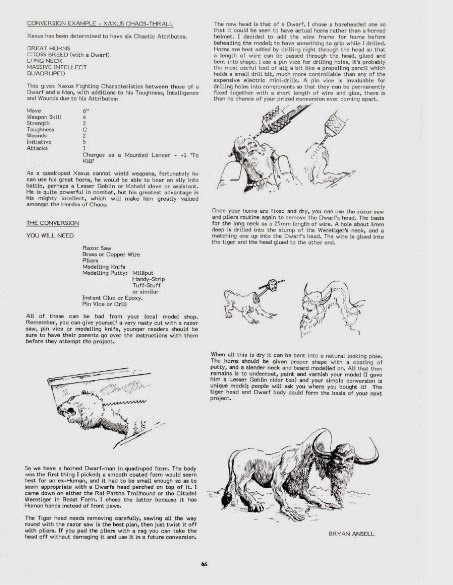
It's a unique conversion by Bryan Ansell, painted by John Blanche, and many of you will recognise it as the Xaxus Chaos-Thrall conversion detailed in the First Citadel Compendium. I've loved that particular article since I first saw it - the situation is one that anybody rolling up chaos attributes finds themselves in: "how the &%@$ am I meant to model that??" And so with the help of razor saw, wire, and milliput, a Citadel Weretiger is given a Dwarf's head with added horns, a unnaturally long neck, and bob's your chaotically malformed uncle.


As one would expect, this was the cue for an old school love-in. Until someone (name redacted to protect the innocent!) decides to break ranks and say: "That model and the painting are so horendously ugly!" Later on the same fellow explained himself a bit more "compared to today's standards, the model is butt-ugly... I admire the thing for the historical value, especially becáuse things have progressed so far and wide. What do you think would have happened if this was made one month ago, and posted on CMoN for example? I'm sure you agree that from an objective standpoint, the model is horrible. The painting is flat and undetailed, the sculpting of the model very basic and out of proportion. It only makes sense when looked at in context of the time this was made, compared to later stuff, the difference is stunning."

Well, that definitely gave me food for thought. I can see where he's coming from, of course. Enamels can look very strange in a world of acrylics, and it certainly doesn't have a naturalistic feel. On the other hand, one could argue that it's not meant to look naturalistic, and the point about being "out of proportion" doesn't really work when the nature of chaos mutations is to distort proportion! To me, it has the feel of something from a medieval bestiary, or a weird creature in the marginalia of a monastic manuscript... not a thing of this world, but a thing of fantasy. But sure, I suppose one has to agree that the technique is crude compared to what we see from virtuoso painters today (and, of course, compared to Blanche's own later virtuoso painting). But is technical skill a virtue in its own right? For me, what this model stands for is the triumph of imagination. Yes, people's craftsmanship and skill at colouring-in may have improved. But is "the hobby" as creative, as imaginative, as open to inspiration? I'm astonished to hear anybody talk about "progress" in this way, especially in this group. Technical progress has been made at the expense of joy.

I am a pretty poor painter myself, and I don't want this to come across as making excuses for poor technique. I like looking at the work of many of the master-painters I've come across in this community, and I do try and learn lessons from the excellent work I see because I want to get better. Many of the people whose blogs I have in my blogroll I follow in part to learn from them. (Whiskey Priest, Thantsants, Asslessman, and others.) But it's never just technique for its own sake... I would always prefer an average paintjob that is memorable and imaginative and tells a story of its own to a virtuoso paintjob that is forgettable. I mean, I looked at Coolminiornot after reading this exchange on facebook, and I agree, there's some amazing technique on display, and probably if this conversion was posted there it would be panned. But here's the thing: after looking at some of the top submissionthere, 5 minutes later I couldn't remember a single one. Absolutely nothing about them stuck in my mind. Why? Because they didn't tell a story, because they didn't capture something imaginative. Whereas that Ansell/Blanche creation is immensely memorable because (in my opinion) it's impossible to look at it WITHOUT telling stories about it. Technique is all very well, but its no guarantee of wonder. That's why I generally prefer quirky 80s sculpts to the perfect CAD models of today. Often they're not accurate or naturalistic, but they make me want to play because I start to imagine the worlds they inhabit and the adventures they'll have.

What I'm saying is that technique, while important, can become the enemy of imagination. If you're so concerned with being "naturalistic", then you're not open to the world of fantasy and the weird and wacky possibilities of the universe of imagination. And if you're so concerned with trying to imitate the technical style of particular experts, then you're giving up control of your own imagination to somebody whose work is held as an ideal. You're just doing cover versions that are never going to be as good as the real thing, when you could be doing something unique instead.

I was reminded of a fantastic article by Matt Stevens in Issue 37 of the RPG fanzine Imazine back in 2002. There he argues "Most rolegamers, it seems, judge artwork on the basis of its realism and professionalism. They condemn the amateurish scribbling of the early rolegames, comparing them unfavourably to the slick colour prints of today. I'm not sure that rolegame artwork is getting any better - in some ways, I'd say it's actually getting worse." Yes, he accepts that the skill of the artists has improved. But the illustrations no longer intrigue the spectator. Good draughtsmanship is on display, but it doesn't conjure up anything in the imagination of the people looking at it. The basic argument that Matt Stevens makes there is that some of the original 1970s D&D monsters manual entries, amateurish as they may be, haunted our imaginations and made us want to play. Do the polished illustrations of the early 21st century do the same?

"What distinguishes the best rolegame artists from the mediocre ones? If you could summarize the difference in one word, it’s imagination. The good ones show us things we never saw before, while the hacks churn out the same stuff over and over again." I agree: and I'd say that if you want to learn about imagination, you'll get more out of that Ansell/Blanche conversion than anything on Coolminiornot. And then... this is the important bit... don't try to imitate it. Instead, do your own thing. Tell your own story.