Showing posts with label Albion. Show all posts

Monday, 20 February 2017

Night of the Living Lead Battle Report: Breakshit means Breakshit

(Being a battle report on the Halloween action at the Wargames Foundry. With the latest of Warlord Paul's Albion adventures coming up at the weekend, I realised that if I didn't post about the last one now, I never would. Problem is, a lot of my recollections of a most enjoyable day are a bit hazy. So this is an extremely partial reconstruction based mostly on the least blurry photos of my toy soldiers as they plod around the battlefield.)

What lurks under Albion's skin? Peel back Albion's flesh, cut through its muscle and sinew, and what horrors do you reveal? The embittered hatred of many centuries. The tarry black heart of greed. Swollen spleen of malice. Infected kidneys of evil. Cirrhotic Liver of... well, you get the picture. Lots of not nice stuff.

Lifetimes ago, a demon was vanquished. Or at least, so the people thought. In fact, it was merely buried. Or, more accurately, as the scribes tell us, "imprisoned beneath a henge of enchanted stones wrapped about with sealing spells and wards."

But now a new dawn approaches. The demon threatens to break free, from the bowels of the earth comes the insistent rumblings of the demon's desire to leave.


And today, the cultists gather around, an unholy alliance, calling the demon forth, urging him out. And so the prophecy has come to pass: "All must take sides for there can be no middle path, all must stand for or against the daemon called, BREAKSHIT!"


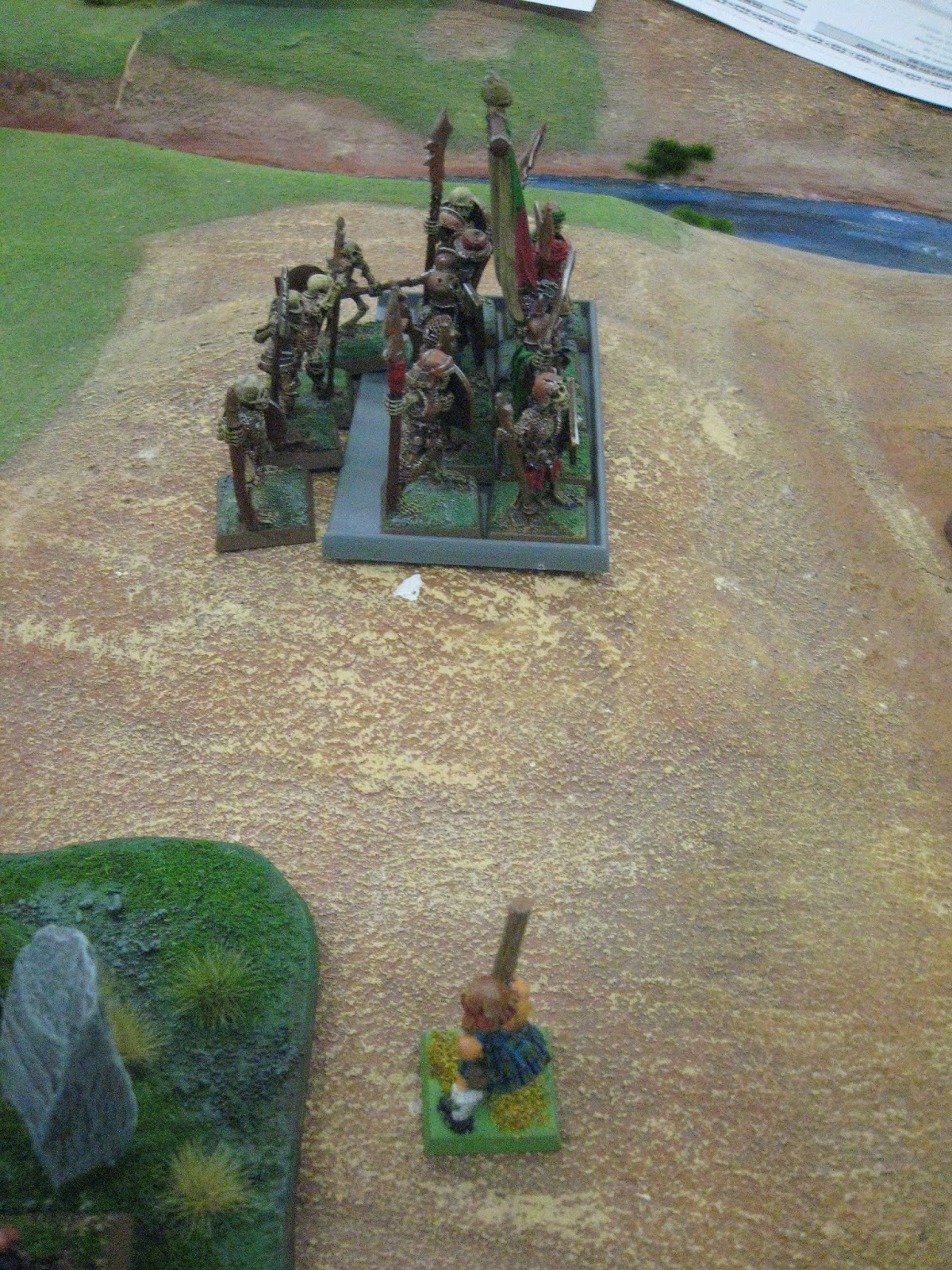
From the highlands come the clansmen, determined to bring sober reason to the proceedings and to stop Breakshit in its tracks. In their midst are the zombies of the Highland cult of Indyref, risen from their graves.

They take their place in the alliance moving toward the henge, determined to stop, or at least amend, the invocation of the ritual summoning Breakshit.

Yet the ancients, the walking dead of Albion, seek a return to the glory days of past ages and will fight to ensure the ritual is performed, believing that Breakshit will allow them to take back control.


Attempts to toss the caber into their number fail miserably.


And as the forces clash, even liquid courage is not enough to withstand the horror.


The cultists succeed in opening the protective seals and a roar swells from the ground: "BREAKSHIT MEANS BREAKSHIT!"


The surviving allies who had hoped that the power would remain captive make their way to the graveyard and enter the catacombs in the hope that if they can at least mount an appeal to stop a Hard Breakshit.


The highlanders bust their way past the venomous serpents who serve Breakshit...


And join a coalition who manage to make a few amendments...


This is fantasy, remember?

Tuesday, 30 August 2016

Battle Report: The Despoliation of the Wirheal


From "Notes from a damp and insignificant islet" by Willhelm von Brissen:
Of the Wirheal, this much can be said: it is a peninsula.


Back during the first weekend of July, VanLoon, Thantsants, and myself gathered for Gauntlet, the Deeside Defenders annual show. Our task: to avoid buying too much from the traders, and to have a small campaign of linked warhammer games with our Chaos Warbands. We failed in the first task, but succeeded admirably in the second. This is a reasonably short account of the campaign we played. I don't have so many pictures, which is partly why it's so abridged.


The backstory
In recent days [in fact, Gauntlet 2014], hordes intent on treasure hunting found and ransacked the chapel of the Forgotten Goddess Deva.

Now the Wirheal is weakened. With the Goddess Deva has been thrown out of her resting place, the land that once slept has been rudely awakened. Bands of marauders pander to the whims of their foul patrons, desecrating the land and pillaging its most sacred locations.

YOU are the champion of a god of Chaos. With your band of miscreants, you are intent on despoiling this corner of Albion. Glory and eternity await: but first you must prove yourself against the followers of rival gods. And the mysteries of the Wirheal will pose their own challenges.

Answering the calls of their respective gods are my Nurgle warband, The Posion Dwarf and the children of stench; Thansants' warband, Boris Forktongue and the followers of Brehkshhit, God of Diminishing Returns; and VanLoon's warband, Dimspittle and the followers of the Divine Tuluk.


Game 1: The Bonks

From "The Highways and Byways of Perfidious Albion" by Willhelm von Brissen:

Near the hamlet of Birwall are the ancient burial mounds known as "the bonks"*. Believed by superstitious folk to be the resting place of the feared warriors of days best forgotten, very few will admit to going near the mounds, and those that have passed by at night speak of unnevering forms and sounds appearing amongst the bonks. Children, characteristically reckless in their youthful exuberance, are much less inclined to treat the mounds with awe, and take great pleasure in the innocent pleasure of rolling eggs down the banks of the mound. Sadly, several children have lost their lives in recent years, torn asunder by the talons of giant eagles and owls while hunting for ever-larger eggs with which to impress their friends.

(* based on true history - there used to be mounds known locally by this name, levelled to make way for Birkenhead Park)

The three warbands converge on the burial mounds, intent on looting them.


Dimspittle, champion of the Divine Tuluk, is the first to reach the a burial mound, but the chill finger of the Barrow Wight defending his barrow is too much for him.


His followers are left to finish the work of robbing the tomb. Their leader may be dead, but they are rewarded with great treasure... a Frostblade!


As the rival factions clash, The Poison Dwarf, Champion of Nurgle, fares better in combat and bursts into the tomb, bringing out a Cursed Blade.


While Boris Forktongue is rewarded with a Spell Shield. (Very useful in a game where nobody has brought any magic users.)


The bonks all well and truly pillaged, the forces of chaos turn their attention to their next target...


Game 2: The Monastery at Birwall

From "And may it sink beneath the waves!: Further enquiries on the topography of Albion; or, why does my editor keep sending me back to this godforsaken rainy backwater?" by Willhelm von Brissen

The hamlet of Birwall would scarsely attract the notice of even the most stimulus-starved of travellers were it not for the monastery here, which offers refuge for the weary and has a monopoly on ferry transport across the river. Though the small community of monks claim to be holy men of great charity, the extortionate rates they charge for safe passage tell a rather different story, as does their stockpile of crude weaponry. The monastery contains a modest library of chained books. Though one would be most foolish in expecting tomes of true learning to be kept in such a place, it is nevertheless possible that some of the manuscripts may be of interest to scholars wishing to understand the backwards beliefs of the people of this corner of the isle.


It is natural that the followers of the Gods of chaos should want to the lay waste to the home of the priests of pious men. Yet they seek out the monastery not only with destruction in their hearts; but also with a lust for the knowledge that will lead to the slow death of the Wirheal itself. They seek the location of the Green Knight, and such knowledge is to be found in the pages of the books in the monastery library. The monks steadfastly block their way.


The campaigners for Brehkshhit and Tuluk reach the doors of the monastery quickly. The monks do their best to prevent them from gaining access, though their incantations have little effect. Meanwhile, the beastmen of nurgle attempt to clear the way of Brehkshhit supporters for their own champion.


The monks turn out to be little more than a nuisance, as Mongo, now de-facto commander of the Tuluk force following the death of Dimspittle, insists that he has first right to access the monastery.


Meanwhile the Poison Dwarf has had to do his own fighting, following the disappointing performance of the beastmen in his charge. He proves more than a match for the Brehkshhit thugs, but quickly finds himself surrounded.


Meanwhile the way is clear for Mongo to enter the monastery library and to find the tome containing the fabled whereabout of the legendary Green Knight. One question remains. Can he read?


While Mongo tries to hold a book the right way up, outside things have got rather messy. The troll Yuukip has spewed up bile, which not only renders the Poison Dwarf incapacitated, but also splashes back onto Boris Forktongue and takes him out too! The followers of Tuluk make good their escape with the knowledge they seek while their rivals clean up the mess.


Game 3: The Chapel in the Woods

From "A Walk in the Woods; or, why don't they cut these trees down? - a modest proposal to speculators about the business opportunities afforded by the exportation of lumber from Albion" by Willhelm von Brissen

Locals speak of a long forgotten "green chapel" in an unknown location deep in the Forest of the Wirheal, associated with a figure of legend known as the "Green Knight". The Green Knight is said to be the champion and defender of the Wirheal. For as long as he lives, the forest shall grow green and thick. But should he die, it is said that the forest will die with him and all manner of wickedness shall emerge from its rotting stumps. Your humble writer's dilligent enquiries revealed that nobody can offer any clue as to the location of the chapel, and as nobody has ever actually seen this so-called knight, such tales can safely be discarded as drunken foolery.


Nestled in the woods are the ruins of the Green Chapel, the location as revealed in the pages written out by monks many generations ago. Mongo and the devotees of Tuluk approach the crumbling walls... but they have been followed!


Mongo crosses the threshold of the chapel first, the beastmen of Tuluk a few steps behind in support of their champion. They try and make good their early arrival as the rival warbands close in.


Hounds from across the marshes chew on the warriors of Tuluk, allowing the Poison Dwarf to pass unmolested.


Meanwhile, Mongo rounds the corner and comes face to face with the Knight Who Says N... I mean, the Green Knight! Frostblade in hand, he charges...


But is overpowered!


As Mongo breathes his last, the Beastmen of Tuluk hold back a minotaur on the steps of the palace, seemingly oblivious to the sound of their leader's failure.


The harpies of Brehkshhit swoop in but can do little damage.


While Boris Forktongue and the Poison Dwarf engage in heated debate, three plague toads of Nurgle fight to consume the body of the Minotaur they have snatched from combat with the beastmen.


The beastmen, meanwhile, advance and, picking up the Frostblade dropped by their leader, attack The Green Knight once more.
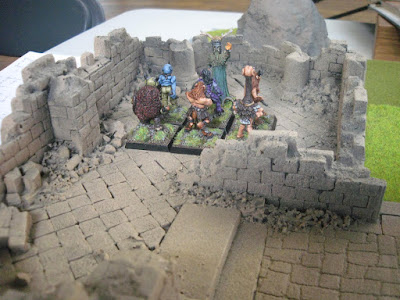

Did they succeed?

Nah. The Wirheal is saved. For now...

Thursday, 3 July 2014

The Forgotten Goddess: background for Gauntlet 2014


Some gods are so frequently troubled by the contradictory requests of men that they are driven to madness. Far luckier are those gods who are forgotten, free from men's desperation, untroubled and at peace.

Such has been the blissful fate of the goddess Deva for many centuries; her temples left forgotten, her shrines covered with ivy and moss. The river that bears her name tumbles by carrying her memories to the sea.

Curse the hunger of the indiscriminate. Curse their greed. To the mouth of the river came the Norse, hungry for plunder, ready to strip whatever meagre ornaments still remained in the places dedicated to the honour of Deva. Their desecration has awakened the goddess. From the highlands came the forces of the Earl McSalmond, drawn to the valley at the goddess' will, though they know not what they defend or why. From the great ocean the goddess called the seafaring elves, knowing that they stood ready to protect that which is sacred.

But the goddess' call was not only heeded by those who could come to her aid. The forces of the blood god hear the call and see the chance to desecrate that which is pure. And now the forces of the god who revels in the destruction of all other gods come to play their part - to foil the plans of the blood god or to feast on what remains of Deva's memory?

Cursed be the day that the goddess Deva was remembered. Cursed be those who would not let her rest in peace.


This Saturday, 5 July, four of us oldhammerers - Warlord Paul, Thantsants, VanLoon, and myself - will converge on Gauntlet, the show run by the Deeside Defenders. It's at the Airbus Dining hall, above the Wings Social Club, Broughton, near Chester. If you're in the area, why not join us? (And a couple of us may return on the Sunday too.)

We're each bringing a small force of around 400 points, so that there's at least a fighting chance we might get a couple of linked games in; Paul's bringing his Unwanted of Malal, a wonderful force put together from the plastic kits given to him by the disenchanted. VanLoon is bringing a Khornate force. Thantsants is bringing some Norse, and I'm bringing some mcdeath style highlanders (I'm hoping to also bring Sea Elves for maximum narrative flexibility). Of course, the best laid plans o' mice an' men gang aft agley, so some of the crucial bits and pieces I wanted for conversions to get my highlanders ready haven't come in the post. That said, I still have a modest force and I think with a bit of imagination and lateral thinking I'll have them ready for the fight. I'm very excited to see what everyone else is bringing.

I've come up with the narrative above to give some explanation as to what we're all doing in this corner of Albion, and I've drawn on some of the local place name history to give it some regional appropriateness. (The picture above is of Minerva's shrine in Chester.) Incidentally, if any of you guys can bring terrain that will help with the background - e.g. anything ruined temple or shrine or monument like, and anything that would work for a river/estuary environment - that would be great. But I reckon we can make a good go of whatever people have to hand!

Will the awakening of Albion's forgotten Goddess rip the land apart? Or will she be allowed to rest in peace, freed from the attentions of a disturbed world?

Thursday, 15 May 2014

One tartan to rule them all?

So I was about to start painting the highlanders that I've got ready for Whiskey Priest's Oldhammer challenge, when suddenly I was paralysed with angst and self-doubt.

Not so much an existentialist crisis as an example of the kind of annoying niggles that crop up everytime I need to make a big painting decision. And the big question causing all the hesitation was this:
Should I paint the kilts of the clansmen all in one tartan, or should I go for a load of different tartans?


An incident in the rebellion of 1746, by David Morier - note the highlanders are wearing several different tartans.

If I was an historic gamer, there might be a somewhat definitive answer to that: if I was wargaming the Jacobite uprising, say, the evidence would point to the fact that the warriors wore a whole gaggle of tartans. Certainly the idea of everyone wearing a common "clan tartan" is a much later development, and in terms of battle dress has more to do with the raising of the Highland Regiments in the 18th century, when each regiment was dressed in a uniform tartan. It's only really with the highly dubious claims of Vestiarium Scoticum of 1842 (largely a historical fabrication - FABRICation, geddit? eh? HAHAHAHAHA oh forget it) that we derive the idea that there was such a thing as historic tartans associated with particular clans, taken up by the Highland Society of London... and kiltmakers have been trading on that ever since. So it's kind of a 19th century fantasy of how Scottish highlanders used to dress. But then, what we're wargaming here is fantasy.

The Albion clansman designed for McDeath, all decked out in their highland dress, inhabit a romantic dream, born of Sir Walter Scott's "Land of brown heath and shaggy wood,/ Land of the mountain and the flood", but in the hands of the Games Workshop designers it's a dream cut through with 1980s British cynicism... competitors at the Highland games become rival football hooligans armed with broken bottles facing off over the playing field. (Incidentally, the Warlord Games "arrant scum" selection of beer swilling highlanders captures this mixture of romance and hooliganism quite nicely.) High fantasy with a vein of snide humour.

Such is the nature of fantasy - the past as it is imagined, and as we use it to tell stories about the present, not than the past as it was lived. So ultimately, the question is which fantasy I want to depict when I come to paint these wee fellows: the fiercely independent highlander banding together with his fellows, or the loyal men tied to kin and territory through unbreakable bonds of blood.

Monday, 24 March 2014

Of Black Shuck, and other terrors

"They do speak of a dog that walks regular. His eyes are big as saucers and blaze wi' fire. He is fair as big as a pony, and his coat is all skeffy-like, a shaggy coat across. He has a lane, and a place out of which he come, and he vanish when he hev gone far enough." - account of a demonic dog near Garveston in Norfolk, from Enid Porter's Folklore of East Anglia.

"Black Shuck, that dog don't give a fu.." - The Darkness, minstrels of Lowestoft


Yesterday saw another nice little gathering of OGRE, the East Anglian regional oldhammer group, with an exciting 3 way battle between Dwarves, Wood Elves, and Fimir around a polluted river. Pictures and a battle report of that encounter to come, but in the meantime I thought I'd keep ya'll updated with the latest additions to my fimir force.

In trying to create an East Anglian theme for my Fen-dwelling fimir, I'm always on the lookout for inspiration from regional folklore. One of the most widespread stories that spread around East Anglia (and to a certain extent persists to this day) is that of a giant ferocious black dog, with glowing demonic eyes - known locally as "Black Shuck".

On the morning of Sunday, 4 August 1577, the people of Bungay were at prayer in their local parish church. The sky was darkened, and a storm had broken, pounding the windows and doors with heavy rain. It was as though hell had broken loose - and then, from out the gates of hell, a beast as black as the storm smashed through the door and launched itself fast as lightning down the nave. Passing between two of the townsfolk kneeling in prayer, it tore into their neck and killed them in an instant. He then launched into a third man, striking him on the back and causing him to shrivel up like leather scorched in the fire, before bounding out as quickly as he had entered. To this day, the scorchmarks from the hellish hound's claws can be seen on the church door.

Another tale of Black Shuck concerns a small blind boy standing with his sister on Thetford Bridge. the blind boy said to his sister: "Please send the big dog away", to which his sister replied, "What dog? There's no dog here." Suddenly the girl felt her brother being pulled away from her and into the water, and only managed to whisk him away home and to safety in the knick of time. Black Shuck's association with the water comes through in many other stories, including the tale of an old lady in Blickling, who told the village parson, "Don't you know that when Arthur was fishing in the lake, he caught an enormous fish and that, when it was landed, a great black dog came out of its mouth? They could never get rid of that dog, who kept going round and round in circles inside the house, till they send for a wise man from London, who opposed the straight lines of the partitions to the lines of the cricles and so quieted the dog. But if these young people pull down the partitions, they will let the dog loose again".

If my fimir force are a manifestation of East Anglian nightmares - the creatures that emerge from the mist and drag you screaming into the fens - it seems clear that I should do something to represent the nightmare of hellish dogs as black as the night and with red glowing eyes. Luckily for me, I'd just picked up for very little a couple of plastic GW sets that someone leaving the 'Games Workshop hobby' was getting rid of, and one of the boxes he was getting rid of were Fenrisian Wolves for a 40K Space Wolf army - perfect to use as Chaos Hounds on the cheap, and fitting the description of Black Shuck quite well.


Can't quite get the glowing eyes in the picture. Need a better camera! But you get the idea. I can imagine the people of albion huddled behind the barred door of an inn, waiting for the sound of the scratching of claws...

I also made a couple of other additions to the force while I was at it - my first attempt at painting a Nick Bibby fimir - this one can act as my warlord. Also, I decided for the scenario we needed a crude war altar. For that purpose I painted up the top of the heroquest rack model, and put it on the backs of two shearl (thralls from Oakbound miniatures' "The Woods" range of Myeri Marsh Demons)


Again, not a great picture, here's another one, this time from yesterday's battle - unfortunately in this picture you can also see my Warlord legging it! Why has he turned and fled? Well, you'll have to wait for my next post to find out!

Saturday, 15 March 2014

Highlanders for the Oldhammer Challenge; or, Albion as a campaign setting


(Arthur Rackham's illustration of the Scots Ballad Twa Corbies)

So I've loads of different projects on the go right now, trying to get things ready for games in the near future. But as I said in my last post, I've been inspired by Whiskey Priest's Oldhammer Challenge. In his words:
"Let's do something to show that it's all about the game and camaraderie rather than the rules and the figures. We each make a warband - a tiny army - a posse, based in the Warhammer world. A maximum of 21 figures. Two units of 10 and a hero or any similar configuration. You are entirely free to do what you want! The figures must be either a) insultingly cheap from ebay or b) easily bought from current manufacturer."

Preach on, Whiskey Priest! And I've been so inspired by this that I've decided it's time to paint these guys:


I can imagine people clucking their tongues and rolling their eyes. "Are you completely thick? Did you not read what Whiskey Priest wrote? Are you just trying to contradict him and prove that oldhammer IS elitist and exclusionary and about wasting money on ebay? Are you just trying to spit in his face and kick him in the bollocks, &c. &c.?"

Well, ok, hear me out. So yes, these are the clansmen from McDeath. They're oop, and although I didn't pay stupid money for them on ebay, they don't fall into the "insultingly cheap" category. So what relevance does this possibly have to Whiskey Priest's challenge? The thing is, for Christmas I was given a bunch of the Warlord Games Highland Clansmen from their Pike and Shotte range. There are some very characterful minis in this range - especially in their "Highlander Arrant Scum" selection. The obvious thing to do? To use these to supplement the expensive and hard to find Citadel McDeath highlanders and show how you can put together an East of Albion force using minis that out there at the moment, alongside just a small handful of oop masterpieces to satisfy the inner archaeogamer.

So this is the start of my warband: 4 Citadel McDeath highlanders; 7 Warlord Games highlanders; and 1 Black Tree Design "Jamie McCrimmon" from the Doctor Who range, who I've given a sickle from S&D models (a company that makes railway scenery accessories).


And to summarise, my reasons for choosing these for the challenge:
1) I already own them, so this is a chance to paint stuff from the leadpile rather than buy new minis.
2) It demonstrates how one can combine old and new minis to do even something as "old school" as McDeath.
3) It feeds into my current fascination, which is using Albion as a campaign setting. And the rest of this post will be about that.


Albion as a campaign setting

In GW's official material, Albion has shapeshifted a lot. Here's the depiction that oldhammerheads know and love from the 1986 campaign pack "The Tragedy of McDeath":

McDeath deals with just one chunk of Albion - East Albion, which, inspired by Macbeth mixed with a heavy dose of the cultural stereotyping that gives shape to the Warhammer world, is a land inhabited by clan-based kilt-wearing porridge-eating caber-tossing highlanders, living alongside militant trade unionist dwarf miners, mercenary orcs, treemen, and others. This is the Albion that inspires my warband.

Then fastforward to 1991 and the Warhammer novel Storm Warriors by Brian Craig:


Here, the map is a clear approximation of the British Isles, but Albion is divided into 4 separate islands, Great Albion, Albany, Morien, and Aeryn, meaning that England, Wales, Scotland, and Ireland each get their own individual island (thus allowing for further stereotyping - just non-comedic in form - by the GW stereotype factory.) From the extracts I've read, the culture described is a predominantly celt-inspired one, and the source of tension in the novel is the arrival of an "alien culture" of sinister immigrant sea elves.

The "Albion as multiple islands" model from Storm Warrior is also used in the following map, which Zhu Bajie has traced back to the (now defunct) Warhammer FRP site "Critical Hit"; bit of Anglo-Saxon thrown in here for good measure:


It's the pre-Roman celtic flavour predominates in the release of the "Giants of Albion", along with druid, as part of the Dogs of War army in the 5th edition era; Albion is the land of ancient Ogham stones and ancient magical forces; mysterious land of myth - at least, until the arrival of the Tilean "Curious Gesar". Then came the 2001 "Dark Shadows" campaign, in which Albion was a single misty, rainy, blighted isle to which Truthsayers (good druids) and Dark Emissaries (naughty druids) summoned great forces; Albion became a battlefield between order and chaos, ripping the land apart.

Here's the map from the start of that campaign:


Now the fact that there's so much variety in the background is a really good thing for the oldhammer gamer, in my opinion, because it leaves Albion open for our own creative imaginations. Let's strip it down to basics.

Deep History
The idea that Albion is home to an older civilisation - as evidenced by the Ogham stones - I think gives a deep rooted mystery to the landscape. I've always found interesting the idea that when the Romans left Britain, they left behind structures that nobody knew how to repair; similarly, I feel that Albion should be full of unsettling reminders that there was something here before, and it's something that we don't understand. Druidic and bardic religious knowledge tries to piece together these mysteries and interpret the landscape.

Topography
The key dynamic of any campaigning land is its landscape and in Albion, we have a land of highlands and lowlands; mountains and marshes, hills and mires. The highland clans of the East of Albion (as per McDeath), then, might be distinct from the more town-minded lowlanders, who trade with the Empire and are therefore far more cosmopolitan in their outlook. Yet the lowlanders are surrounded by the sinister bogs and fens where the Fimir dwell; and attempts to drain the marshes to create fertile farmland and increase the wealth of the kingdoms have led to increasing numbers of Fimir raids.

The sea, the sea
As a land surrounded by sea, Albion would have a history of settlement, trading, and raiding. Norse from the west and Sea Elves from the east would send ships to the shore; their motives sometimes peaceful, oftentimes not.

I'll probably type up more of my thoughts at a a later date, but I'm deliberately keeping this to bare bones, because I think the storytelling should come through gaming. Anyway, I hope it gives you the sense that when I'm painting up this bunch of guys in kilts, it's not just about the figures, the nostalgia, or the ruleset - it's about the story, and thinking about the world they inhabit and the way they link up with the other forces I have is all part of that process of storybuilding.

What do other people think about Albion as a campaign setting? Have I missed any key essentials out? Anyone else want to play a game there?